Friday, May 19, 2017


ORIGIN OF CHINESE DESIGN
ORIGIN OF CHINESE DESIGN
ORIGIN OF CHINESE DESIGN
Gardens can be traced back to ancient times in China, but always included the same basic elements. After the Han dynasty, Daoist ideals of disengaging from worldly concerns gave a rationale for gardens as environments in which an individual could escape the often harsh demands of a politically engaged civic life.
Gardens were originally simple retreats for contemplation set in nature. Early exponents of the ideal of retreat from public life, like the legendary Seven Sages of the Bamboo Grove of the Six Dynasties period, merely sought their own retreat in a ready-made natural setting such as a wooded area or mountain stream. From the Han dynasty onward, some individuals built more elaborate precincts that were based on the models of the imperial grounds. One aristocrat lost his life for assuming for himself this royal privilege, flaunting his wealth with a collection of natural specimens similar to those previously found only in the emperors Hunting Park.

Daoist immortals were believed to inhabit remote mountain peaks and practice secret methods of elixir-making there. Portraits of other religious figures, like the Buddhist lohan at the left, were often situated in a landscape with magical qualities. The deer in this painting is a symbol of the Buddha because it is believed a deer was one of his early incarnations.
Certain plants and animals were favored for gardens because of their associations with overcoming the limits of ordinary life. Some trees or plants, for example, grew against harsh odds, such as difficult terrain, and certain animals, such as cranes, seemed to possess an ability to survive in ways beyond human capability.
What objects can you identify in this painting that might have carried such symbolic associations?
Fengshui (or wind-and-water, or geomancy) also played a large role in the form a garden would take. The natural environment was interpreted by the fengshui master as a living organism, the alteration of which could positively or negatively affect the lives of people in contact with it for generations to come.
Follow this link for more on fengshui.
The lore of mountains and rocks, important in Chinese religion and art, was also an indispensable part of garden landscape design. Large rocks placed by themselves or groupings of smaller rocks served as analogies for mountains, which were considered sacred sites and potential resting places for immortals.
One of the most common implements found in tombs from the Han dynasty onward was the incense burner. Below is a typical example of this kind of object.

What features of a mountain would appeal to a Daoist?
Which features do you see here, and why might they be so exaggerated?
The emperor, as guardian of the realm, sought to demonstrate a harmonious relationship with and an intimate knowledge of the forces of nature. The imperial parks were vast in territory and kept an abundance of all imaginable plants and animals, almost like a museum. Such parks replicated the emperors realm in miniature, with man-made lakes and mountains often corresponding to real geographical features. They reinforced the emperors role as the Son of Heaven.
By the Tang dynasty, a tradition of painting the royal hunting parks as paradise landscapes had developed. This gradually came to be applied to representations of landscapes in general.
What might be the purpose of depicting such a dramatic contrast between size of people and mountains in the scene below?
Sometime during the Tang dynasty, miniature landscapes in trays (or penjing), composed of rocks, plants and water, began to take the place of the censers (see above). These small-scale landscapes still retained their otherworldly associations. Especially favored were highly contorted rock and plant specimens. Scholars often kept these dwarfed landscapes on their desks, and one Tang dynasty court magician was said to have cultivated the ability to disappear into his tray landscape at will. Collecting unusual rock and plant specimens became common literati pastimes from the Song Dynasty onward.


The selection of plants for the garden also carried meaning. Private garden builders at first followed the examples of the emperor in collecting exotic plant and animal life in a complete miniaturized version, or microcosm of the realm. In the Song Dynasty, however, many scholars took up garden planning as a cultivated pursuit, writing handbooks on growing a wide number of flower varieties and the collecting and appreciation of unique and valuable rock specimens. There were many private retreats in the estates of scholars in and around the larger cities of Kaifeng, Hangzhou, and Luoyang.
Garden construction reached a peak during the Ming and Qing dynasties, as landholding aristocratic and scholar elite families moved their main residences from the countryside to urban and suburban areas of southern cities. Suzhou in particular became a place of refined culture, renowned for its canals and mild climate, as well as the ready availability of garden building expertise.
Available link for download
Thursday, May 18, 2017
Outrageous Retcon of a Beloved Comic Characters Origin!
Outrageous Retcon of a Beloved Comic Characters Origin!
Thanks to Brad Curran for letting me know about this outrage. Now, Id like to think that I am a reasonable enough of a fellow, and I wont fly off the handle at an innocuous change to a characters origin. But this is just too much. TOO MUCH, I say. The creators involved clearly have NO respect for the characters origin. NONE, I say! Now, before you click on the "Read More," please prepare yourself for a real shock to your system.
The year was 1971.
We should all have been prepared for it, but we werent.

The cover of Amazing Spider-Man #94 mentions the re-telling of the origin, but it cannot even BEGIN to prepare us for the disrespect about to be heaped upon the Amazing Spider-Man, one of the most beloved superhero characters ever!

Right off the bat, there is a problem. The spider bite occurs the same, but LOOK at Peter Parker!
THIS is how Peter Parker is supposed to look - a normal, geeky looking guy.
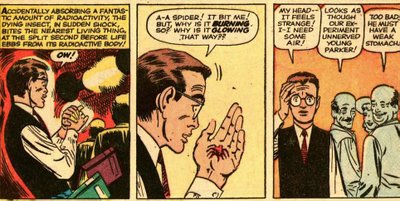
Look at how they retconned Peter into looking like!

Hes practically a jock!!
Next, Amazing Spider-Man #94 introduces a fight that NEVER happened in the original version!

And the fight makes no sense! Think of Spider-Mans secret identity!!
Luckily, the new version follows the original with the jumping in the air part.
Original...

New version...

However, right after that, the original version says...

The new version?
THEY RET-CONNED CRUSER HOGAN OUT OF THE COMIC!
Can you believe it?
One of the most important figures in Spider-Man history, and he doesnt even appear in Spider-Mans origin?!?!
Next problem is Spider-Mans costume.
The original version made sense. First Spider-Man created the costume, THEN he invented the webspinners.

In the new version?
LUNACY!
Webspinners THEN costume!
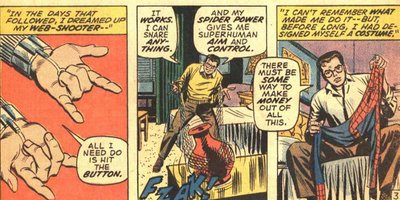
WHY ARE THEY DOING SO MANY RIDICULOUS RETCONS?!?!
The next disaster is the encounter between Spider-Man and the robber.
In the original, it makes perfect sense - Spider-Man meets the robber as hes leaving after a TV special (which has been perfectly set up by his wrestling victory).

The new, disrespectful version?
It makes NO sense!
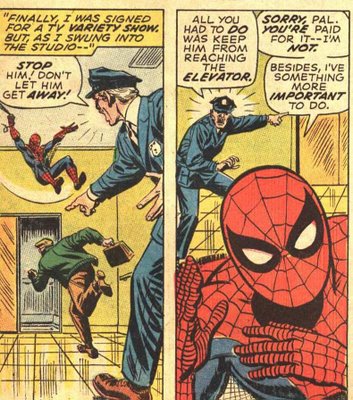
Spider-Man meets the robber as hes ENTERING the TV station! ENTERING?!?! Do they think were morons or something!?!? And without the wrestling scenes, we have no idea HOW Spider-Man even GOT a TV special!!! OUTRAGE!!
The final outrage is Spider-Mans confrontation with the robber.
Heres the logical, original version.


Now, heres the over-the-top retconned version...

I feel like plucking my eyes out and setting them on fire, with the outrage I have at the changes these HACKS made!!
TOTAL disrespect for the characters.
Who WERE these hacks?
#94...lets see the credits....
Stan Lee and John Romita?
It FIGURES.
Marvel Editors in Chief always have a way of screwing Spider-Man over.
I smell an online petition a-brewing!!
Read More
Available link for download
Wednesday, May 17, 2017
Out of my head
Out of my head
K loves music in the car. The confusing thing is that he makes up names for all the songs he likes, but I dont know which name goes to which song. For example, he will demand to hear "mommys song" when in fact, I had no idea I have my own song!! Apparently, "mommys song" is actually M.I.A.s "Galang", which is a pretty fun song from the Live at KEXP Volume 2 CD - if I werent driving, I would dance too! Anyways, I need to make notes on these things, really!
This video was taken a few months ago when J was driving, and Kades song of the day, "out of my head," (Tegan and Saras "Back in Your Head") played on repeat at least 5 times, but the cuteness was worth it!
Available link for download
Tuesday, May 16, 2017
Origin Of Ratha Yatra Story Of Ratha Yatra History Of Ratha Yatra
Origin Of Ratha Yatra Story Of Ratha Yatra History Of Ratha Yatra
To slaughter Lord Krishna and Balram, Kansa, their maternal uncle, welcomed them to Mathura. He sent Akrur with a chariot to Gokul. As asked, Lord Krishna, alongside Balram, sat on the chariot and left for Mathura. The enthusiasts commend this day of flight as Rath Yatra.

Euphoric enthusiasts praised the day when Lord Krishna, aftr vanquishing the malevolent Kansa, gave them darshan in Mathura in a chariot with his sibling, Balaram.
Aficionados in Dwarika praised the day when Lord Krishna, joined by Balaram, took Subhadra - his sister, for a ride on a chariot to demonstrate the citys quality.
When Lord Krishnas rulers asked for mother Rohini to portray the numerous intriguing passionate scenes (ras lilas) of Lord Krishna with the Gopis. Rohini- - thinking of it as inappropriate of Subhadra to hear such scenes (Leela)- - sent her away. Still, the Vrajkatha soon retained Subhadra alongside Krishna and Balram, who at this point had showed up on the scene. While they were totally immersed with the stories arrived Narad. On finding the kin standing together still, he asked, "May you three gift darshan in this way until the end of time." The shelter was allowed. Whats more, the three everlastingly live in the Puri Temple of the Lord Jagannath.

There is an energizing story of Lord Krishna turning into the Sarathi - driver of Arjunas chariot, amid the 18-day skirmish of the Mahabharata.
At last, a story which has been passed on from mouth to mouth, tells what happened after the cremation of Lord Krishnas mortal body.
At the point when Shri Krishna was being cremated in Dwarika, Balaram, greatly disheartened with the advancement, hurried out to suffocate himself into sea with Krishnas mostly cremated body. He was trailed by Subhadra. In the meantime, on the eastern shore of India, King Indradyumna of Jagannath Puri envisioned that the Lords body would coast up to the Puris shores. He ought to construct a monstrous statue in the city and bless the wooden statues of Krishna, Balaram and Subhadra.
The bones (asthi) of Lord Krishnas body ought to be placed in the empty in the statues back. The fantasy worked out. The lord found the chips of bone (asthi) and took them. Be that as it may, the inquiry was who might cut the statues. It is trusted that the Gods planner, Vishwakarma, landed as an old woodworker. He made it clear that while cutting the statues no one ought to aggravate him, and on the off chance that anyone did, he would vanish leaving the work unfinished.
A few months passed. The restless Indradyumna opened the entryway of Vishwakarmas room. Vishwakarma vanished quickly as he had cautioned some time recently. In spite of the unfinished statues, the ruler purified them; setting Lord Krishnas heavenly soot in the empty of the statue and introduced them in the sanctuary.
A superb parade is done with the statues of Lord Krishna, Balaram and Subhadra, consistently, in three huge chariots. The enormous chariots are pulled by aficionados from Janakpur to the sanctuary in Jagannath Puri. The statues are changed like clockwork - the new ones being fragmented moreover.
The Jagannath Puri Temple is one of the four most consecrated sanctuaries in the four bearings of the India- - the other three being: Rameshwar in South, Dwarka in West and Badrinath in the Himalayas. Perhaps, the sanctuary in Jagannath Puri is the worlds exclusive sanctuary with the statues of three divinities who are kin - Lord Krishna, Balabhadra and Subhadra.
Available link for download
Monday, May 15, 2017
Oceanhorn Monster of Uncharted Seas ™ PREMIUM v 1 0 0 Android
Oceanhorn Monster of Uncharted Seas ™ PREMIUM v 1 0 0 Android
 Oceanhorn ™

La única pista que tienes es un viejo diario y un misterioso collar. ¿Qué habrá pasado?
Explora las islas de los Mares inexplorados, un mundo lleno de peligros, rompecabezas y secretos. Enfréntate a monstruos, aprende a usar la magia y descubre tesoros antiguos que te ayudarán en tu misión. Usa todo tu ingenio y tus habilidades para revelar los misterios del antiguo reino de Arcadia y del monstruo marino llamado Oceanhorn.
Oceanhorn combina una cautivadora historia con impresionantes gráficos 3D y una emocionante mecánica de juego, lo que resulta en una fascinante experiencia de acción y aventuras que jamás olvidarás.


Dattos? MEGA
Of All the Things 2012 Full Movie Free Download Watch Online
Of All the Things 2012 Full Movie Free Download Watch Online
+Full+Movie.jpg "Of All the Things (2012) Full Movie")
.jpg "Of All the Things (2012) Full Movie")
.jpg "Of All the Things (2012) Full Movie")
Available link for download
Sunday, May 14, 2017
On the eve of Albert Woodfoxs 5th Circuit oral arguments Amnesty International demands his immediate release
On the eve of Albert Woodfoxs 5th Circuit oral arguments Amnesty International demands his immediate release

After decades of appeals and counter-appeals, delays and diversions, the 5th Circuit Court will review Judge Bradys decision to overturn Alberts conviction tomorrow.
Years and years of efforts to bring attention to this case and to see that justice is finally done will culminate in the outcome of this important hearing.
If you are intending to attend the hearing, please refer to our last newsletter for detailed information on time, place and court-room etiquette. If youre watching from afar as so many of us are, we hope that you will join us in sending all of our prayers, thoughts and energy towards a positive ruling that will lead to Alberts release.
We have to believe that all the hard work to shed light on this horrific case will ultimately lead to Alberts freedom.
Join us in focusing all our attention on this final and crucial hearing to bring Albert home.
Free Albert Woodfox and all political prisoners!
 |
| (PHOTO: Artwork displayed at Herman Wallace’s memorial service, with Herman calling for Alberts release. See more photos of the memorial service by Ann Harkness.) |
Featured below are statements released January 6, 2014 by both Amnesty USA and Amnesty Internationals Media Centre, on the eve of Albert Woodfoxs oral arguments before the Fifth Circuit Court in New Orleans on Tuesday, January 7 (see also postings by Amnesty Suisse and France).
Following that is an email action alert sent on January 3 that declared "Drop the vengeance! Free Albert Woodfox!" It called on supporters to sign the petition calling on Alberts immediate release.
Amnesty International USA Calls on Louisiana to Release Albert Woodfox
Contact: Natalie Butz, nbutz@aiusa.org, 202-675-8761, @AIUSAmedia
(WASHINGTON, D.C.) - On the eve of a federal court of appeals hearing on the case of Albert Woodfox, Amnesty International USA is calling on authorities in Louisiana to immediately release Woodfox from prison where he has spent over four decades in solitary confinement.
"Louisiana cannot extend the abuses and injustice against Albert Woodfox another day," said Steven W. Hawkins, executive director, Amnesty International USA. "Louisiana authorities are leading a campaign of vengeance instead of upholding justice. Keeping Woodfox in solitary confinement for over four decades is a dark stain on human rights in the United States and globally. Louisiana must withdraw its legal appeal and allow the federal court ruling to stand. Should this not occur, the Court of Appeal should rule in the interests of justice and pave the way for Albert Woodfoxs release."
On January 7, the 5th Circuit Court of Appeals (the federal court that oversees appeals in Louisiana and other states) will rule whether to uphold a federal district judges ruling issued last February that overturned Woodfoxs conviction. The state of Louisiana has appealed asking for the federal court to reinstate the sentence.
"The state of Louisianas action is not in the interests of justice," said Tessa Murphy, USA campaigner at Amnesty International. "Its insistence on keeping Albert Woodfox behind bars after decades in solitary confinement amounts to a campaign of vengeance, paid with taxpayers money. The conviction has been overturned three times in what is a deeply flawed case, yet Louisiana has opposed every remedy ordered by the courts."
Albert Woodfox was placed in solitary confinement over 41 years ago in Louisiana State Penitentiary, known to many as "Angola." During this time, he has been confined to a small cell for 23 hours a day, denied access to meaningful social interaction and rehabilitation programs.
Prison records show that Woodfox has not committed any serious disciplinary infractions for decades and that he doesnt pose a threat to himself or others.
He and Herman Wallace were both convicted of the 1972 murder of prison guard Brent Miller. There was no physical evidence to link them to the crime and their convictions relied primarily on the dubious testimony of a sole eyewitness who received favorable treatment, and was eventually pardoned, for his testimony. The case against them was based on flawed evidence and riddled with procedural errors that have been extensively documented over the years.
Both men robustly denied any involvement in the crime. They believe they were falsely implicated in the murder because of their political activism in prison as members of the Black Panther Party.
Herman Wallace was released in October 2013 just days before he died of liver cancer. A federal judge overturned his conviction on the basis of the systematic exclusion of women from the grand jury during his 1974 trial.
"A remedy to the injustice inflicted on Albert Woodfox by the state is long overdue," said Murphy. "Herman Wallace gained his freedom only to die within days. Justice must not again be so cruelly delayed."
After the death of Herman Wallace, Albert Woodfoxs co-defendant in the "Angola 3" case, Amnesty International launched a campaign calling on the state of Louisiana to release Albert Woodfox from prison by means of withdrawing its appeal against the U.S. District Courts ruling.
Amnesty International is a Nobel Peace Prize-winning grassroots activist organization with more than 3 million members in more than 150 countries campaigning for human rights worldwide. The organization investigates and exposes abuses, educates and mobilizes the public, and works to protect people wherever justice, freedom, truth and dignity are denied.
 |
| (PHOTO: Herman Wallace, on left, with Albert Woodfox, on right) |
USA: End four-decade campaign of vengeance and release Albert Woodfox
Authorities in the US state of Louisiana must end their campaign of vengeance against Albert Woodfox and release him after nearly four decades of cruel solitary confinement, Amnesty International said on the eve of a Federal Court of Appeals hearing on his case.
“The state of Louisiana’s action is not in the interests of justice. Its insistence in keeping Albert Woodfox behind bars after decades in solitary confinement amounts to a campaign of vengeance, paid with taxpayers’ money,” said Tessa Murphy, USA campaigner at Amnesty International.
“It is incomprehensible that the state continues to keep him behind bars. This conviction has been overturned three times in what is a deeply flawed case, yet Louisiana has opposed every remedy ordered by the courts.”
On 7 January, the 5th Circuit Court of Appeals (the Federal Court that oversees appeals in Louisiana and other states) will rule whether to uphold a federal district judge’s ruling issued last February that overturned Woodfox’s conviction. The state of Louisiana has appealed asking for the Federal court to reinstate the sentence.
“Louisiana should withdraw its legal appeal and allow the federal court ruling to stand. Should this not occur, the Court of Appeal should rule in the interests of justice and pave the way for Albert Woodfox’s release,” said Tessa Murphy.
Albert Woodfox was placed in solitary confinement over 41 years ago in Louisiana State Penitentiary, known to many as “Angola”. During this time, he has been confined to a small cell for 23 hours a day, denied access to meaningful social interaction and rehabilitation programmes.
Prison records show that Woodfox has not committed any serious disciplinary infractions for decades and that he doesn’t pose a threat to himself or others.
He and Herman Wallace were both convicted of the 1972 murder of prison guard Brent Miller. There was no physical evidence to link them to the crime and their convictions relied primarily on the dubious testimony of a sole eyewitness who received favourable treatment in return for his testimony. The case against them was based on flawed evidence and riddled with procedural errors that have been extensively documented over the years.
Both men robustly denied any involvement in the crime. They believe they were falsely implicated in the murder because of their political activism in prison as members of the Black Panther Party.
Herman Wallace was released in October 2013 just days before he died of liver cancer. A federal judge overturned his conviction on the basis of the systematic exclusion of women from the grand jury during his 1974 trial.
“A remedy to the injustice inflicted on Albert Woodfox by the state is long overdue,” said Tessa Murphy.
“Herman Wallace gained his freedom only to die within days. Justice must not again be so cruelly delayed.”
Background information
Louisiana must end its campaign of vengeance against Albert Woodfox (press release).
Justice deferred to the end (press release).
USA: 100 years in solitary: The Angola 3 and their fight for justice (report).
After the death of Herman Wallace, Albert Woodfox’s co-defendant in the “Angola 3 case”, Amnesty International launched a campaign calling on the state of Louisiana to release Albert Woodfox from prison by means of withdrawing their appeal against the US District Court’s ruling.
AI Index: PRE01/001/2014
 | |
| (PHOTO: Michael Mable, the brother of Albert Woodfox, speaks at the press conference and delivery of petition to free Albert at the Louisiana State Capitol on Oct.21, 2013.) |
Drop the vengeance! Free Albert Woodfox!
(Email Action Alert sent by Amnesty USA on Friday, January 3, 2014)
This could be the end of Albert Woodfoxs 40-year plus prison nightmare, if you act now.
On Tuesday morning, Jan. 7, the 5th Circuit Court of Appeals in New Orleans will hold a hearing to determine Alberts fate. Will they finally act on the 2013 ruling that overturned his conviction and set him free, or shut the door and send him back to another unthinkable year in solitary confinement?
Federal courts have overturned Alberts conviction 3 times. The state of Louisiana has appealed 3 times.
Enough is enough.
Tell the state of Louisiana to end its campaign of vengeance and let Albert go.
Nothing can justify the cruel treatment that Louisiana authorities have inflicted on Albert, one of the famed Angola 3 prisoners.
For decades, the authorities have punished Albert with solitary confinement. Hes survived 40 years living in a tiny cell for 23 hours a day, denied meaningful human contact and rehabilitation.
In a deeply flawed verdict, Albert was convicted of murder even though no physical evidence ties him to the crime, the state lost potentially exculpatory evidence, and authorities bribed their key witness.
Albert maintains he was put in solitary confinement in retaliation for organizing prisoners against segregation and other abuses in Louisiana State Penitentiary, also known as "Angola".
Its simply unconscionable for the state to hold this man one day longer.
Please help Amnesty International demand freedom for Albert Woodfox.
Please take action before the Jan. 7 hearing.
Thanks for standing by Albert, and for all you do to defend human dignity for all.
Sincerely,
Jasmine Heiss
Campaigner, Individuals and Communities at Risk
Amnesty International USA
 |
| (PHOTO: Amnesty USAs Jasmine Heiss spoke at the Louisiana State Capitol on Oct. 21, 2013.) |
Available link for download
Wednesday, May 10, 2017

Tuesday, May 9, 2017
Nunu Advent Calendar of Stuff She Likes to Chew December 21st
Nunu Advent Calendar of Stuff She Likes to Chew December 21st

Available link for download
Monday, May 8, 2017
Opening the Box Sarah Shourd on Herman Wallace California Hunger Strikers and the Horror of Solitary Confinement
Opening the Box Sarah Shourd on Herman Wallace California Hunger Strikers and the Horror of Solitary Confinement
READ: Herman Wallace and Nelson Mandela: A Tale of Two Heroes (Ebony Magazine)
Please take Action for Herman Wallace of the Angola 3 by joining Amnesty Internationals call to release him on humanitarian grounds! There are action pages for the: USA, United Kingdom, France, Belgium, and everywhere else.
 |
| (Recent photo of Herman: No Shackles!) |
In recent years, Amnesty has initiated other campaigns challenging the over 41 years spent in solitary confinement by Herman and Albert Woodfox, also of the Angola 3, including the April 17, 2012 delivery of a 67,000 signature petition to LA Governor Jindal demanding Albert and Hermans immediate release from solitary. Earlier this year, Amnesty called on Louisiana Attorney General James Caldwell to not appeal the US District Court’s overturning of Albert’s conviction. More recently, accompanying their call for Herman’s release, Amnesty also expressed concern about “the worsening conditions of confinement” for Albert at David Wade Correctional Center, where he remains in solitary confinement. “For approximately two months, Woodfox has been subjected to additional punitive measures – including strip searches each time he leaves or enters his cell, being escorted in ankle and wrist restraints, restricted phone access, and non-contact visits through a perforated metal screen. Temperatures in the prison cells are reportedly extremely high, regularly reaching up to 100 degrees Fahrenheit,” wrote Amnesty.
 |
| (PHOTO: Sarah Shourd speaks in support of solitary survivor Bradley Manning) |
Available link for download